What's the difference between AC and DC electricity, and how does that affect how your EV charges? Here's a clear, plain-English explanation of AC vs DC charging and why it matters
If you've done any reading about EV charging, you'll have noticed that chargers are described as either AC or DC, and that DC chargers are faster. But why? What does the difference between alternating current and direct current actually have to do with how quickly your car charges? And what determines which type of charger is which?
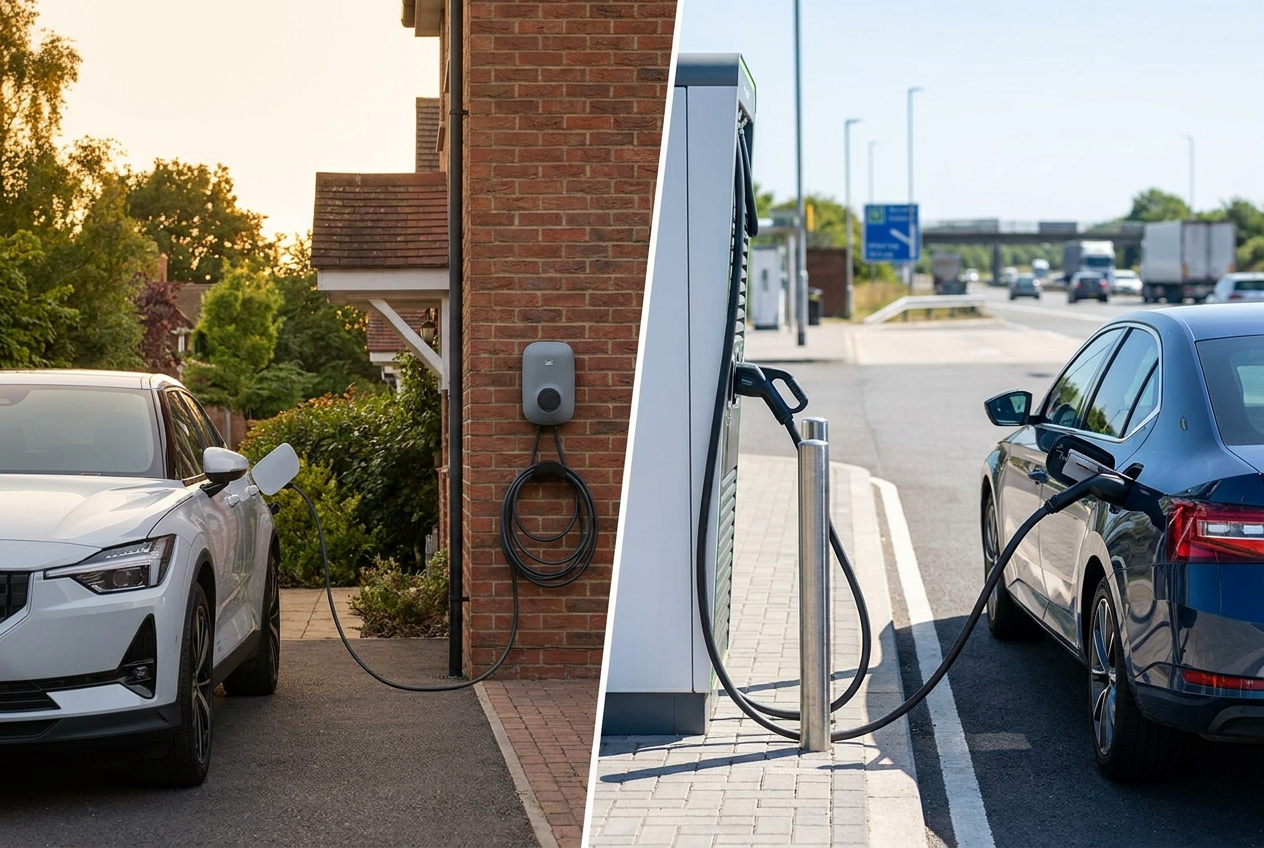
This guide answers those questions from first principles, in plain English, no electrical engineering degree required.
The basics: what are AC and DC?
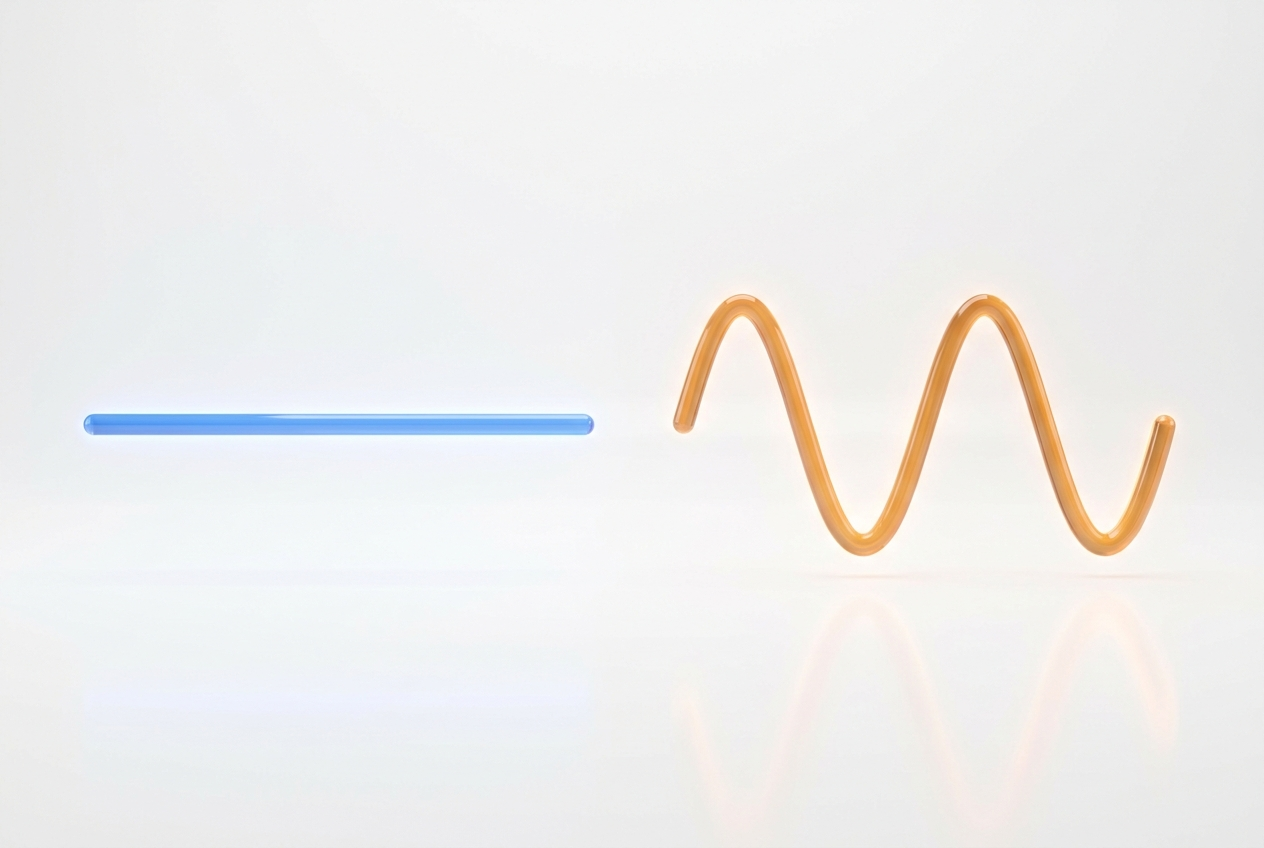
Direct Current (DC) flows in one direction only, from one terminal to the other in a continuous, steady stream. A battery produces DC. The electrical energy stored in your phone, your laptop, and your EV's battery pack is all stored and used as DC.
Alternating Current (AC) flows back and forth, reversing direction many times per second. In New Zealand, the grid supplies AC at 50 cycles per second (50Hz), meaning the current reverses direction 100 times per second. The power outlets in your home supply AC. The national grid transmits electricity as AC because it travels long distances with far less energy loss than DC would at equivalent voltages.
The fundamental tension in EV charging comes from this simple mismatch: the national grid delivers AC, but your EV's battery can only store DC. Something has to convert one into the other, and where that conversion happens is the key difference between AC and DC charging.
AC charging: the onboard charger does the conversion
In AC charging, the charging station or wall unit delivers AC power from the grid to the vehicle. Inside the vehicle is a component called the onboard charger, which is actually an AC-to-DC converter. The onboard charger takes the incoming AC electricity and converts it into DC that can be stored in the battery.
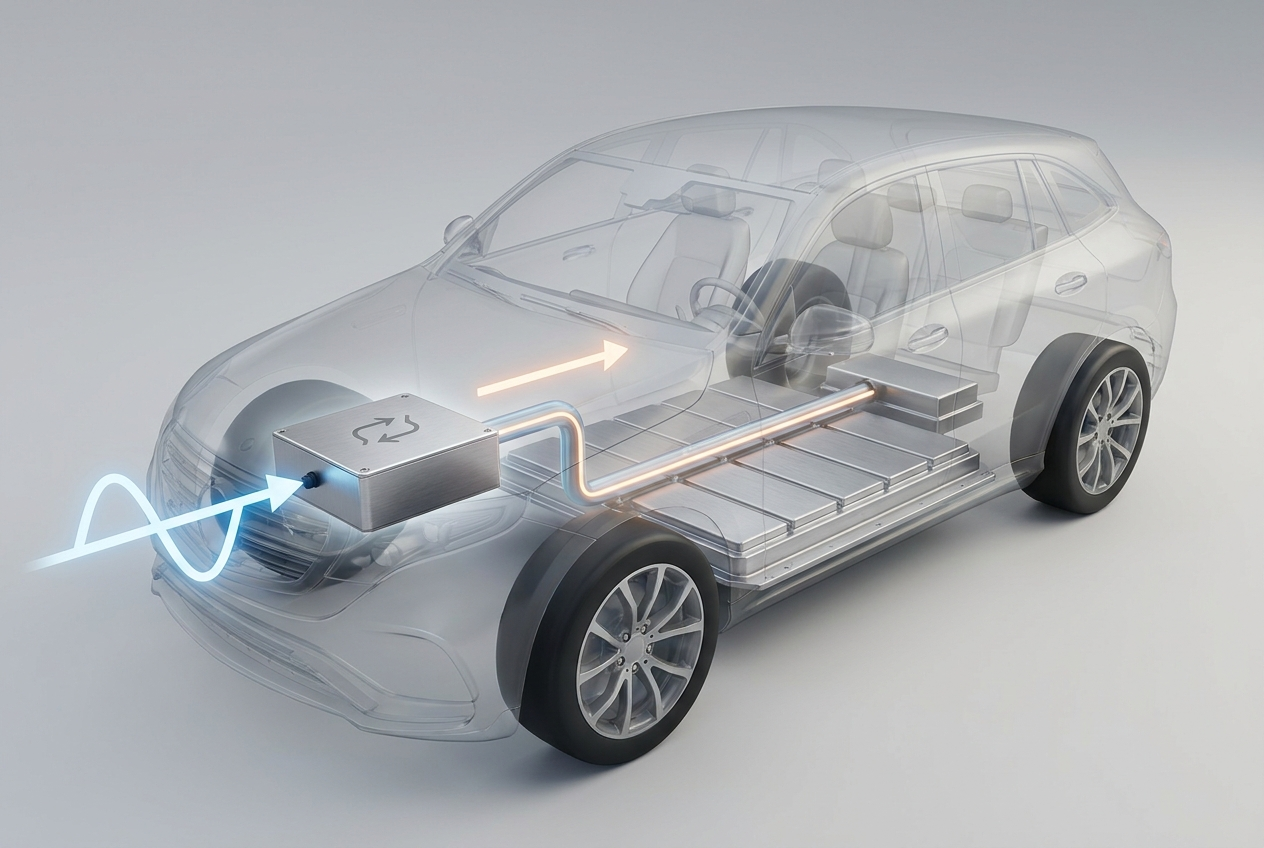
Because the conversion happens inside the vehicle, the speed of AC charging is limited by the capacity of the car's onboard charger. Most standard EV onboard chargers handle 7.2kW on a single-phase power supply (the most common residential supply in New Zealand). Some vehicles support 11kW or 22kW on three-phase power, but these are less common in the residential context and are more relevant to commercial premises.
This is why home charging is AC charging. The charging cable that came with your EV, your home wallbox charger, and most destination chargers at shopping centres, supermarkets, and car parks all deliver AC. The conversion work happens inside your car.
Speed: Typically 7–22kW. Adding roughly 40–120km of range per hour at home on a standard 7.2kW wallbox. Slower, but fine for overnight home charging and opportunistic top-ups during a long stop.
DC charging: the charging station does the conversion
In DC charging, the AC-to-DC conversion happens inside the charging station itself, not inside the vehicle. This changes everything about the speed that's possible.
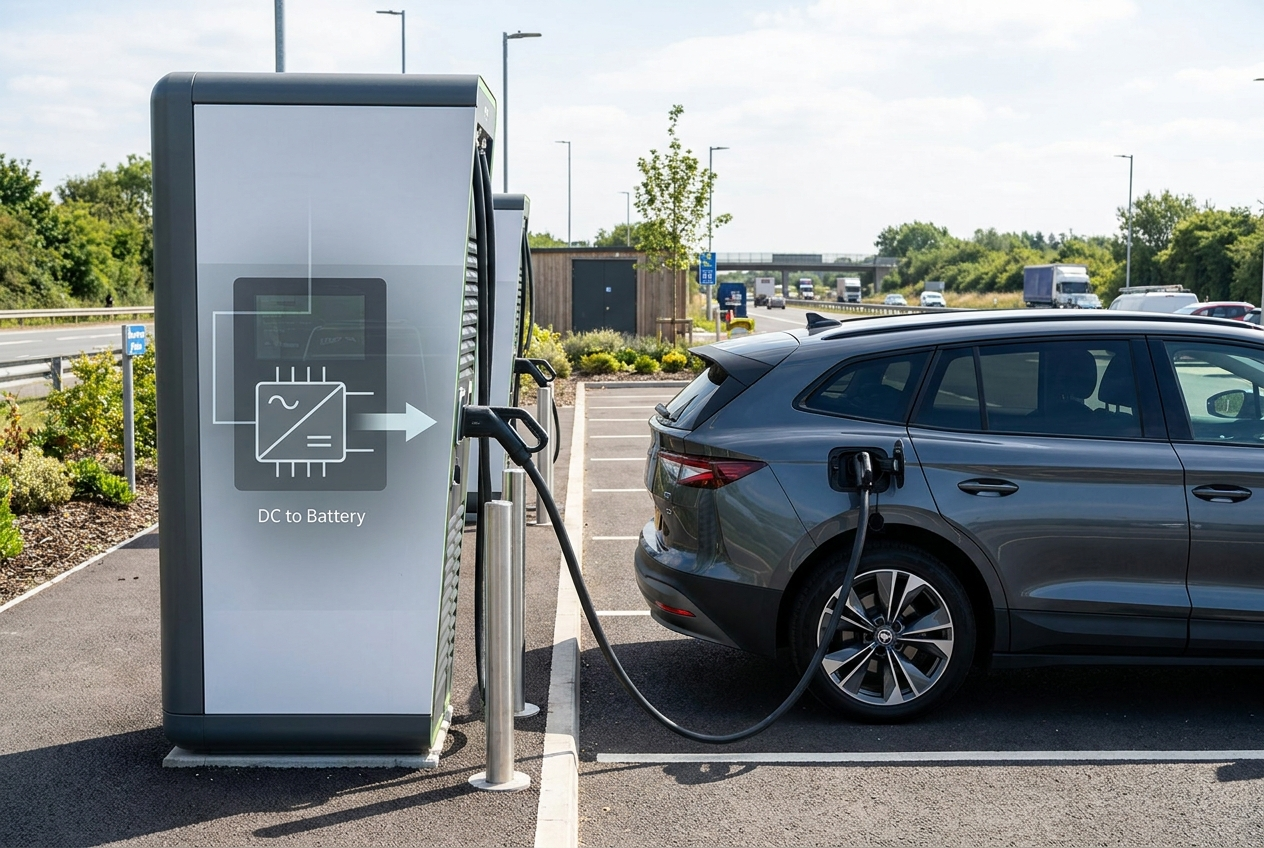
Because the conversion is done by industrial-grade equipment in the charging station rather than the relatively modest onboard charger in your vehicle, DC charging stations can deliver vastly higher power. A typical public DC fast charger in New Zealand delivers 50–150kW. Some ultra-rapid chargers on the network deliver 300kW or more. The converted DC power is fed directly into the vehicle's battery, bypassing the onboard charger entirely.
This is why DC fast chargers are so much quicker. It's not that they're using fundamentally different or better energy, it's that the conversion bottleneck (the onboard charger) is removed from the equation, allowing the charging station to push much higher power directly into the battery.
Speed: Typically 50–350kW depending on the station and vehicle capability. Adding 100km of range in 15–30 minutes at a public fast charger. The right choice for road trips and any time you need a substantial top-up quickly.
The vehicle's charging capability also matters
Here's an important nuance: even if you plug into a 150kW DC fast charger, your vehicle may not be able to accept 150kW. Every EV has its own maximum DC charging rate, determined by the battery management system and the hardware in the vehicle itself.
A Nissan Leaf (40kWh, standard variant) accepts a maximum of 50kW DC. Plug it into a 150kW charger and it'll charge at 50kW regardless. A Hyundai Ioniq 5 with an 800V architecture can accept up to 220kW, plug that into a 150kW charger and the charger becomes the limiting factor.
The actual charging speed is always determined by whichever is lower: the charger's rated output, or the vehicle's maximum accepted rate. This is why checking your specific vehicle's onboard AC charging capacity and maximum DC charge rate matters, particularly when comparing models.
Why does charging slow down near 100%?
You may have noticed that EVs charge quickly to around 80% and then significantly slow down for the last 20%. This is intentional battery management, not a fault.
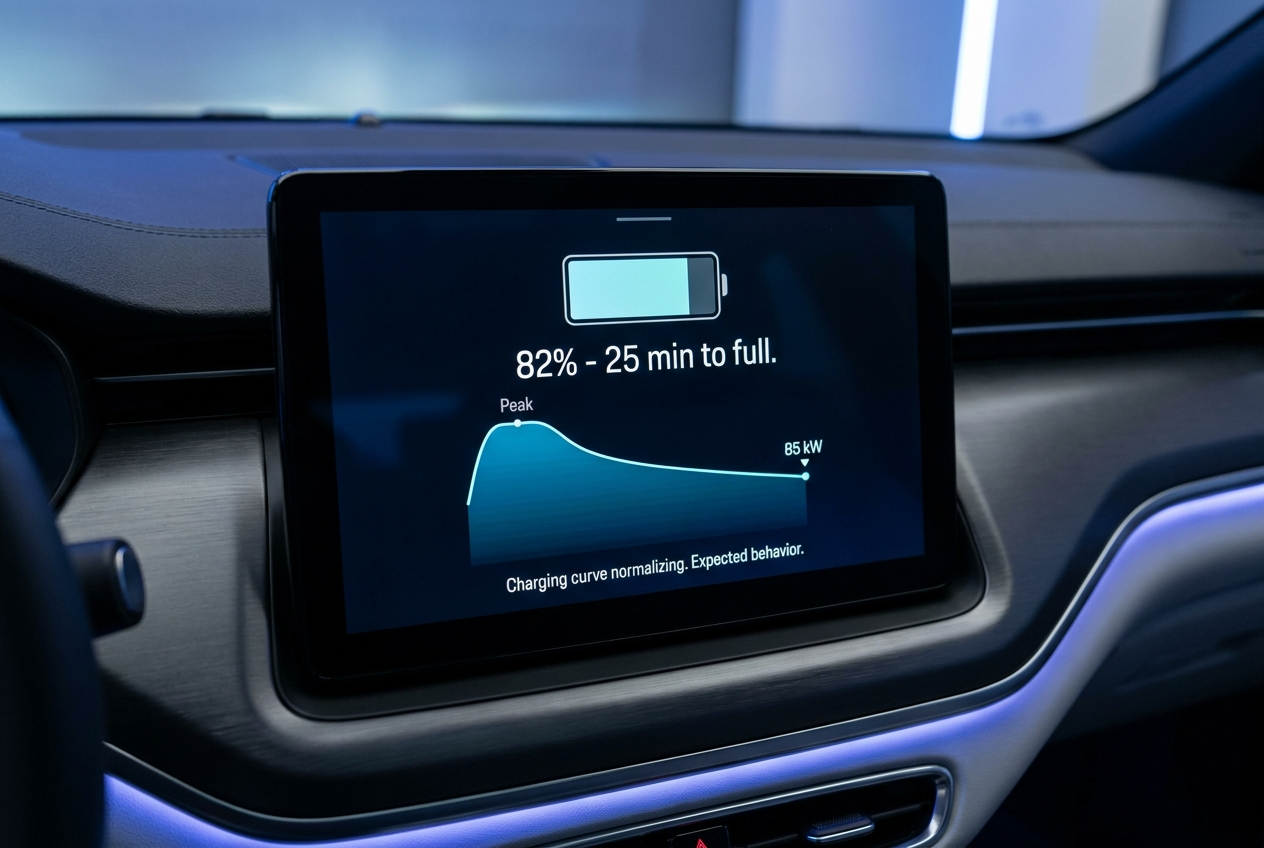
As a lithium-ion battery cell approaches full charge, the chemical reactions inside slow naturally, pushing more energy in faster risks overheating, accelerating degradation, and in extreme cases, causing damage. The battery management system progressively tapers the charging rate above 80% to protect battery health. This is true for both AC and DC charging, but is most noticeable at DC fast chargers where you'd otherwise expect high speed throughout.
The practical implication: if you're charging at a public DC fast charger and paying by the minute, stopping at 80% is often significantly better value than charging to 100%, you'll have added the bulk of your range for a fraction of the cost of those final, slow-to-fill percentage points.
Connectors: which plug does what?
Different charging standards use different physical connectors, and understanding which your vehicle has matters for knowing which chargers you can use.
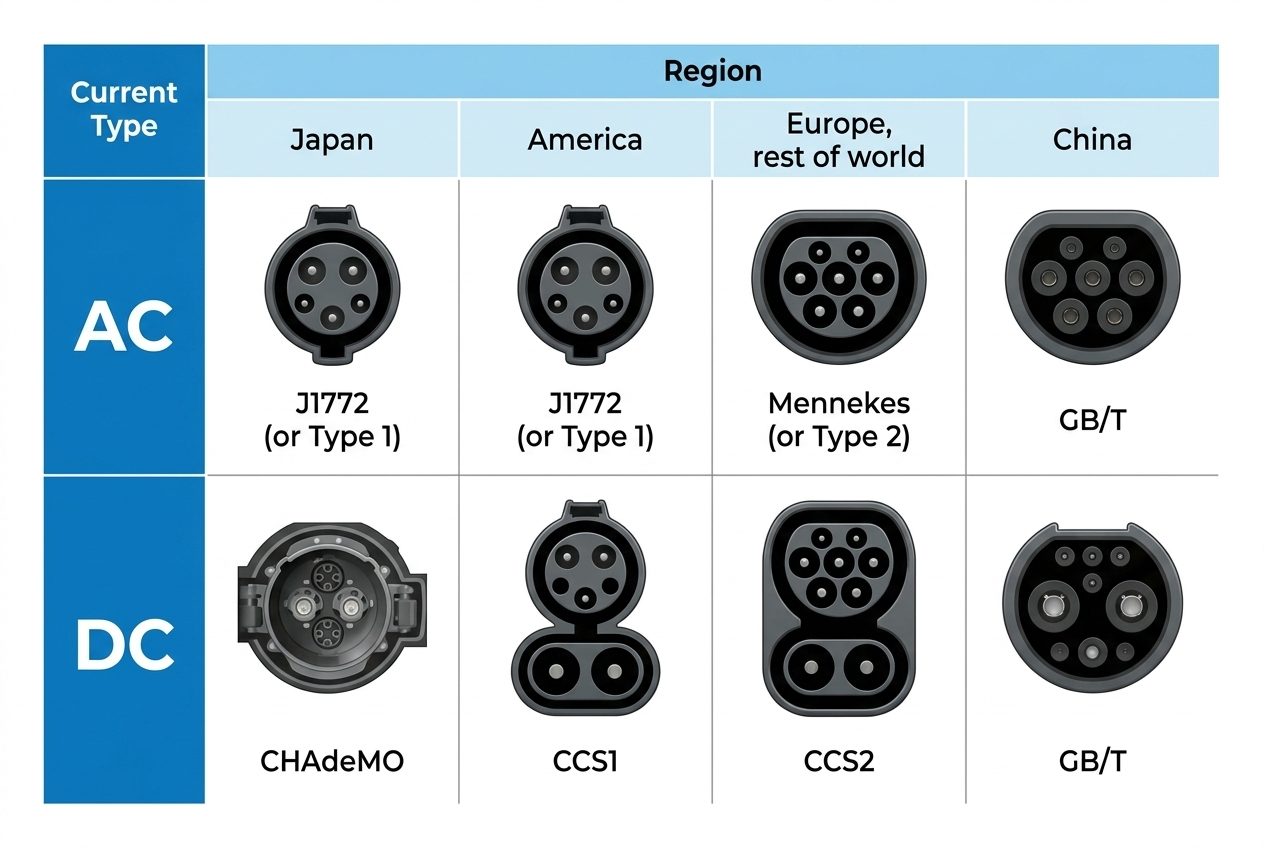
For AC charging:
- Type 2 (Mennekes): The standard connector for AC charging in New Zealand, Europe, and Australia. Used on most new EVs and home wallbox chargers. NZ-new vehicles use Type 2.
- Type 1 (J1772): Older standard, still common on Japanese imports
For DC fast charging:
- CCS2 (Combined Charging System): The modern standard for DC fast charging in New Zealand and Australia. Used on most NZ-new EVs from 2020 onwards. CCS2 combines an AC Type 2 socket with additional DC pins.
- CHAdeMO: Older DC standard, predominantly used on Japanese imports. The Nissan Leaf uses CHAdeMO for DC charging. Still supported on most NZ public DC chargers, but being phased out as a global standard.
- Tesla Supercharger (NACS/Type 2): Tesla has historically used a proprietary connector, though NZ-new Teslas use Type 2 (AC) and CCS2 (DC). Some Japanese import Teslas use NACS.
Most public DC chargers in New Zealand provide both CHAdeMO and CCS2 tethered cables, covering the majority of vehicles on NZ roads.
A simple summary
| |
AC charging |
DC charging |
| Conversion happens |
Inside the vehicle (onboard charger) |
Inside the charging station |
| Speed limiting factor |
Vehicle's onboard charger capacity |
Station's output OR vehicle's max DC rate |
| Typical power |
7–22kW |
50–350kW |
| Typical use |
Home, destination, overnight |
Road trips, quick top-ups |
| NZ connector (standard) |
Type 2 |
CCS2 or CHAdeMO |
| Cost |
Cheaper (home rate) |
More expensive per kWh |
The bottom line
Most EV owners do most of their charging on AC, overnight at home on a 7.2kW wallbox, quietly refilling the battery while they sleep. DC fast charging is there when you need range quickly: a road trip stop, an unexpected longer day, or a top-up before a long drive when you left home without enough charge.
Understanding the AC/DC distinction helps you know what to expect from different chargers, why your charge speed varies, and why plugging into a faster charger doesn't always mean a faster charge. Once you grasp the basic principle, AC comes from the grid, DC is what the battery stores, and the conversion happens either in the car or in the charger, the rest follows naturally.
Disclaimer
The content in this post is based on our own research, experience, and opinion and is intended for general informational purposes only. It does not constitute professional electrical or technical advice. While we strive for accuracy, specific charging speeds, connector standards, and vehicle capabilities vary by make, model, and year and are subject to change. We encourage readers to consult their vehicle's manufacturer documentation for model-specific charging guidance.
Target keywords: AC vs DC electricity explained, AC vs DC EV charging, how does EV charging work AC DC, alternating current direct current EV explained
Last updated: June 2026