Confused about BEVs, PHEVs, and hybrids? Here's a plain-English breakdown of how each works, what they cost to run in NZ, and which type actually suits your driving.
| With petrol prices climbing past $3.30 a litre and economists warning of further rises, more Kiwi drivers than ever are asking the same question: should I switch to a hybrid, a plug-in hybrid, or go fully electric? The terminology alone trips a lot of people up, and the rules around what each one costs to run have changed significantly in the past couple of years. |
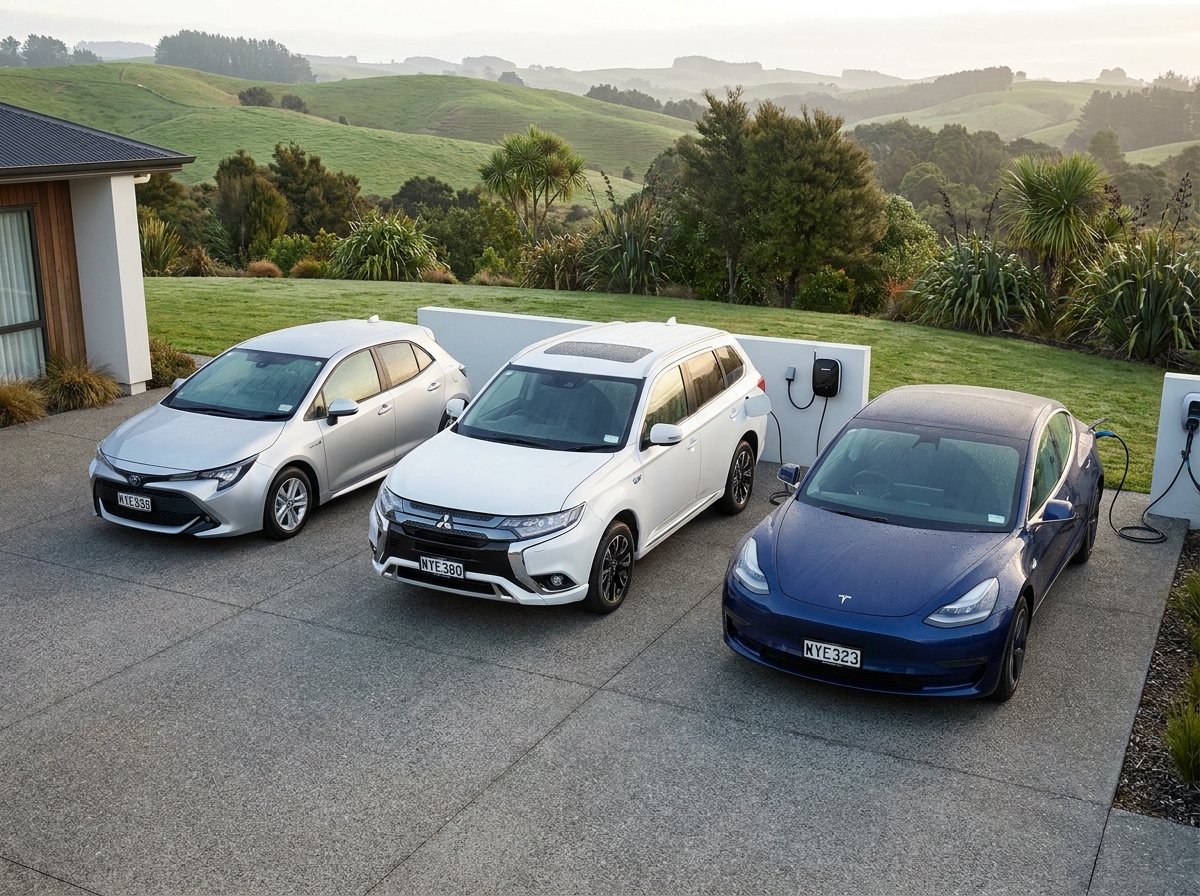 |
This guide cuts through the jargon, explains exactly how each type works, what it actually costs in New Zealand in 2026, and which one suits different kinds of drivers.
The three types, in plain English
|
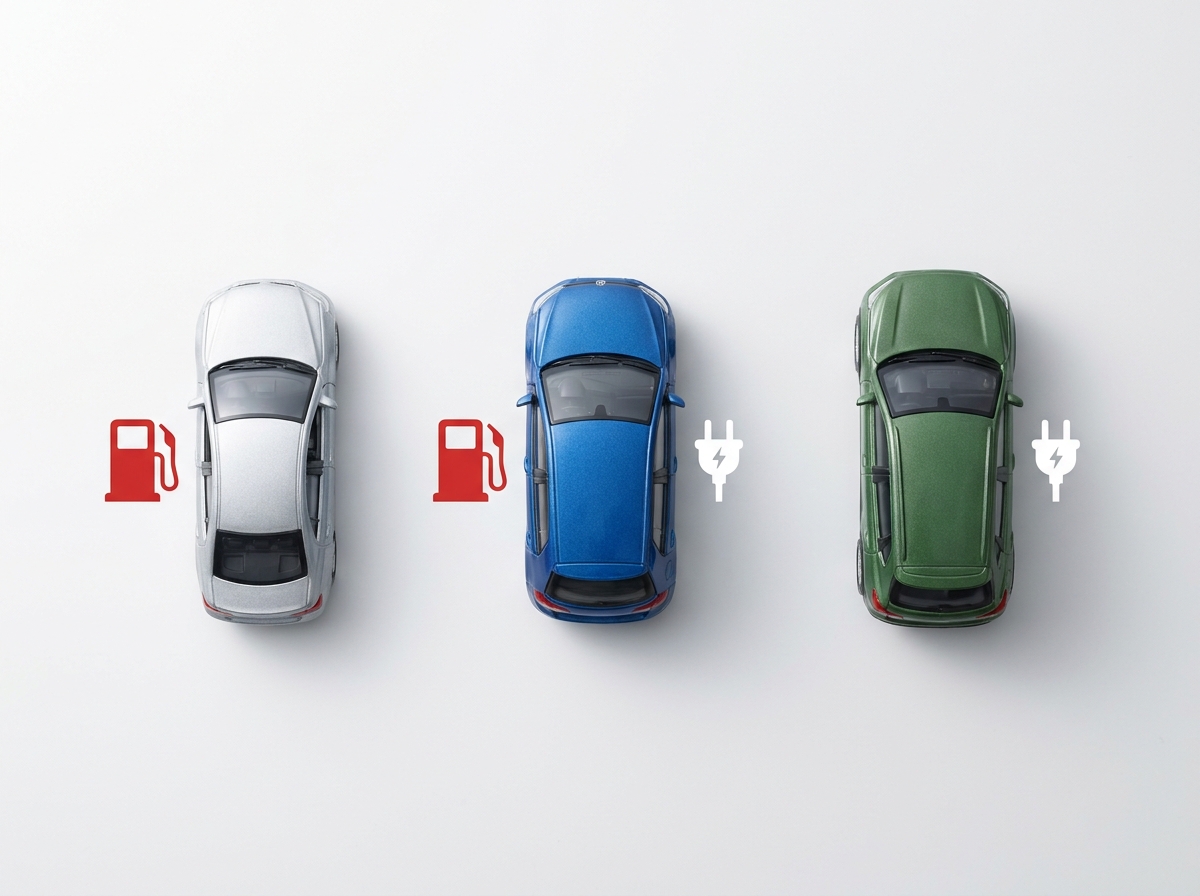
Hybrid (HEV) — combines a petrol engine with a small battery and electric motor. The battery charges itself automatically through regenerative braking and the engine, you never plug it in. It can drive on electric power alone for very short bursts, typically a few hundred metres to a couple of kilometres at low speed, with the petrol engine taking over the rest of the time.
Plug-in hybrid (PHEV) — has a much larger battery than a standard hybrid, which you charge by plugging in at home or at a public charger. This larger battery lets a PHEV drive meaningful daily distances, typically 55–100km, with newer "super hybrid" models extending this further on electric power alone before automatically switching to hybrid mode using the petrol engine.
Battery electric vehicle (BEV) — runs entirely on electricity with no petrol engine at all. You charge it by plugging in, either at home or at a public charging station, and it has no exhaust, no fuel tank, and far fewer moving parts than either of the other two options.
|
 |
How they actually drive day to day
A hybrid feels almost exactly like a normal petrol car to drive, you fill it up at the pump, you never plug it in, and the electric assistance happens quietly in the background, mostly noticeable at low speed and in stop-start traffic.
A PHEV feels like an EV for your daily commute and a petrol car for everything else. If you plug in every night and your trips fall within the electric range, you might rarely use a drop of petrol. Forget to plug in, or take a longer trip, and it simply behaves like a hybrid.
A BEV requires you to actually manage charging as part of your routine, but for most owners this just means plugging in overnight, the same way you'd plug in your phone. There's no engine to maintain, no fuel pump, and considerably less to go wrong mechanically.
What each one costs to run in New Zealand (2026)
| This is where the real decision making detail lives, and where the rules have changed meaningfully over the past two years. |
 |
Road User Charges (RUC): Since April 2024, PHEVs in New Zealand pay RUC of $38 per 1,000km. BEVs pay the full rate of $76 per 1,000km. Standard hybrids that can't be plugged in are currently exempt from RUC because they pay fuel excise duty at the pump instead, though the government has signalled plans to eventually move all petrol vehicles, including hybrids, onto a RUC-based system, with legislation expected in 2026 and a new system potentially launching in 2027.
Fuel and electricity: A BEV is the cheapest to fuel by a wide margin, charging at home overnight is equivalent to roughly $1.60 per litre of petrol, including RUC. A hybrid uses considerably less petrol than an equivalent non-hybrid car but still pays full pump prices for every kilometre. A PHEV sits in between, genuinely cheap if you charge regularly and your trips stay within electric range, but reverting to ordinary petrol costs once the battery is depleted.
Purchase price: Hybrids are generally the cheapest to buy, BEVs the most expensive, and PHEVs sit somewhere in the middle, though the gap has narrowed noticeably as EV prices have come down and hybrid technology has spread across more affordable models.
Maintenance: BEVs have the simplest maintenance profile, no engine oil, no timing belt, no exhaust system, and brake pads that last far longer thanks to regenerative braking. Hybrids and PHEVs still carry a full petrol engine, which means they need the same servicing a conventional petrol car would, on top of managing the battery and electric components.
Insurance: BEVs tend to carry the highest premiums, largely due to battery replacement costs in the event of damage. Hybrids are generally the cheapest to insure, with PHEVs again sitting in between.
A realistic cost comparison
Based on New Zealand's average annual driving distance of around 11,500km, and 2026 fuel and electricity pricing:
A BEV remains the cheapest to fuel in pure energy terms, charging at home overnight typically costs roughly a third of what an equivalent hybrid spends on petrol. But on a full total-cost-of-ownership basis, the picture is closer than it used to be. Hybrids benefit from lower purchase prices, slower depreciation, cheaper insurance, and (for now) no RUC, advantages that can outweigh a BEV's lower running costs once you account for the higher upfront cost and steeper early depreciation typical of EVs.
The honest takeaway: on pure running costs, BEV wins. On total cost of ownership over a typical 4–5 year hold, the gap has narrowed considerably, and for some buyers a hybrid or PHEV will work out cheaper overall, particularly if your budget is tighter at the purchase stage.
Which one actually suits your driving?
|
Choose a BEV if:
- You can charge off-street at home or at work overnight
- Most of your driving falls within the vehicle's real-world range
- You want the lowest running costs and the simplest maintenance
- You're comfortable planning ahead for occasional longer trips using public fast charging
Choose a PHEV if:
- You regularly drive longer distances beyond a typical BEV's comfortable range
- You can charge at home or work most nights, and your daily distance fits within the electric-only range
- You want flexibility, EV running costs most days, with the simplicity of refuelling with petrol for longer trips without any charging stops at all
- You're not ready to fully commit to charging infrastructure but want to reduce fuel costs significantly
Choose a hybrid if:
- You don't have access to off-street parking or can't install a home charger
- You do a lot of stop-start city driving, where hybrids are at their most efficient
- You want meaningfully better fuel economy than a petrol car with zero change to your routine, no plugging in, no charging to think about
- You want the lowest-risk, most familiar ownership experience while still cutting fuel costs
|
 |
The bigger picture for New Zealand
New Zealand's EV market continues to grow, supported by improving model availability, an expanding public charging network, and increasing business and fleet adoption. But the transition isn't one-size-fits-all, plenty of organisations and individual buyers are taking a phased approach, using a mix of BEVs, PHEVs, and conventional hybrids to balance upfront cost, daily practicality, and environmental goals.
There's also an environmental dimension worth noting: BEVs driven in New Zealand produce around 80% fewer CO2 emissions than equivalent petrol cars, thanks to the country's heavily renewable electricity grid, and even accounting for the emissions involved in battery production, BEVs still come out roughly 60% cleaner than petrol equivalents over a full vehicle lifecycle.
The bottom line
There's no single "best" answer here, only the option that's best for how you actually drive, charge, and budget. If you can charge at home and your daily distances are comfortably within range, a BEV will almost always be the cheapest and simplest to run long-term. If you need the flexibility of unlimited range without giving up most of the savings, a PHEV is a genuine middle ground. And if charging isn't realistic for your situation, a hybrid still delivers meaningful fuel savings with none of the behavioural change.
Want help working out which option suits your specific driving patterns and budget? Browse our current range of BEVs, PHEVs, and hybrids, or get in touch with our team for a no-pressure conversation about what makes sense for you.
Disclaimer
The content in this post is based on our own research, experience, and opinion and is intended for general informational purposes only. It does not constitute professional financial, technical, or legal advice. While we strive for accuracy, figures, regulations, and pricing referenced — including RUC rates, fuel and electricity prices, and government policy timelines — are subject to change and may vary by circumstance. We encourage readers to conduct their own research and consult qualified professionals before making any significant purchasing or financial decisions.
Last updated: June 2026