How does electricity actually make an EV move? Here's a plain-English explanation of how electric motors work, from basic electromagnetism to permanent magnet and induction motors, and why they're so good.
The electric motor is one of the most elegant pieces of engineering in any vehicle, simpler and more efficient than a petrol engine, with fewer moving parts, better response, and an almost eerie smoothness. Yet for many people who've made the switch to electric, exactly how the motor actually converts electricity into motion remains a bit of a mystery.
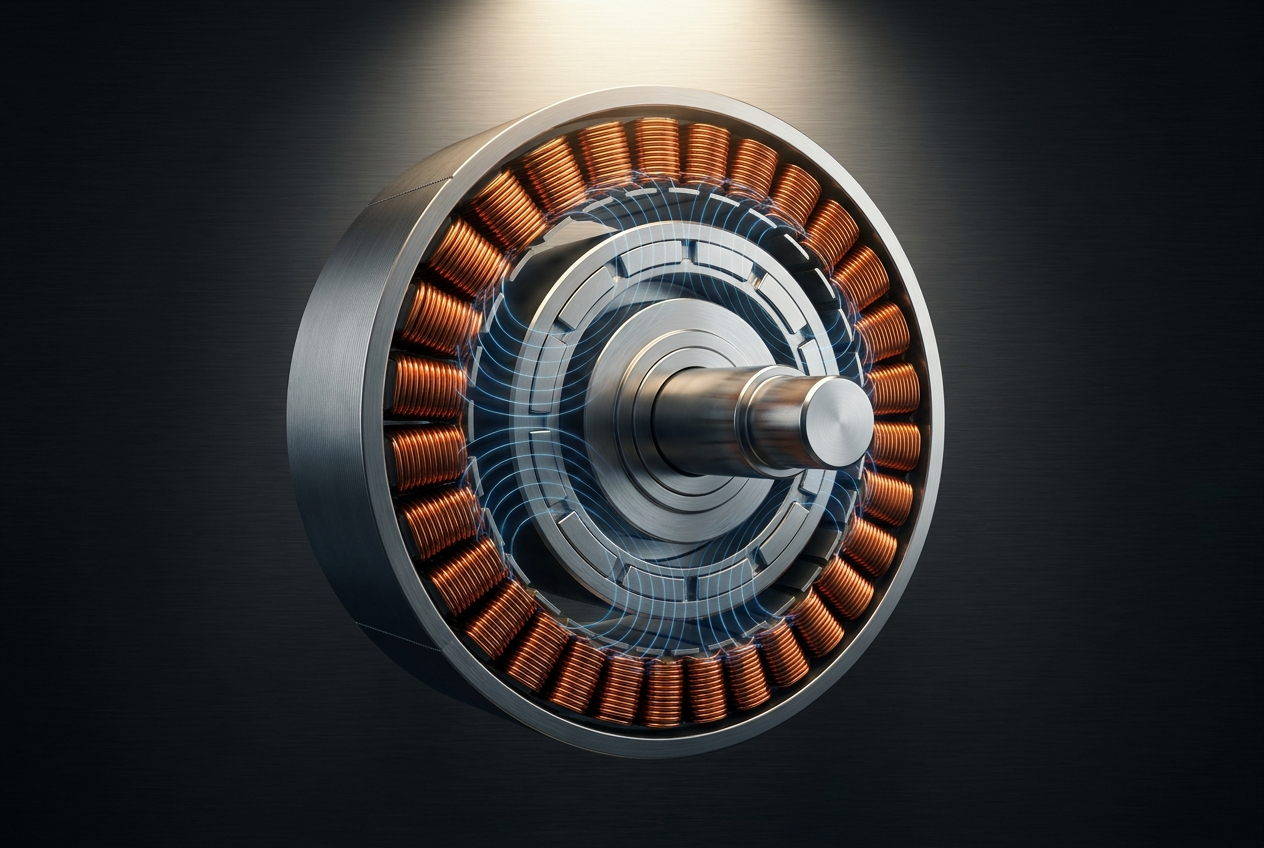
This guide explains it clearly and simply, from the basic physics of why motors work, to the different types used in EVs, to why they're able to deliver such immediate, linear power.
The core idea: magnetism makes things move
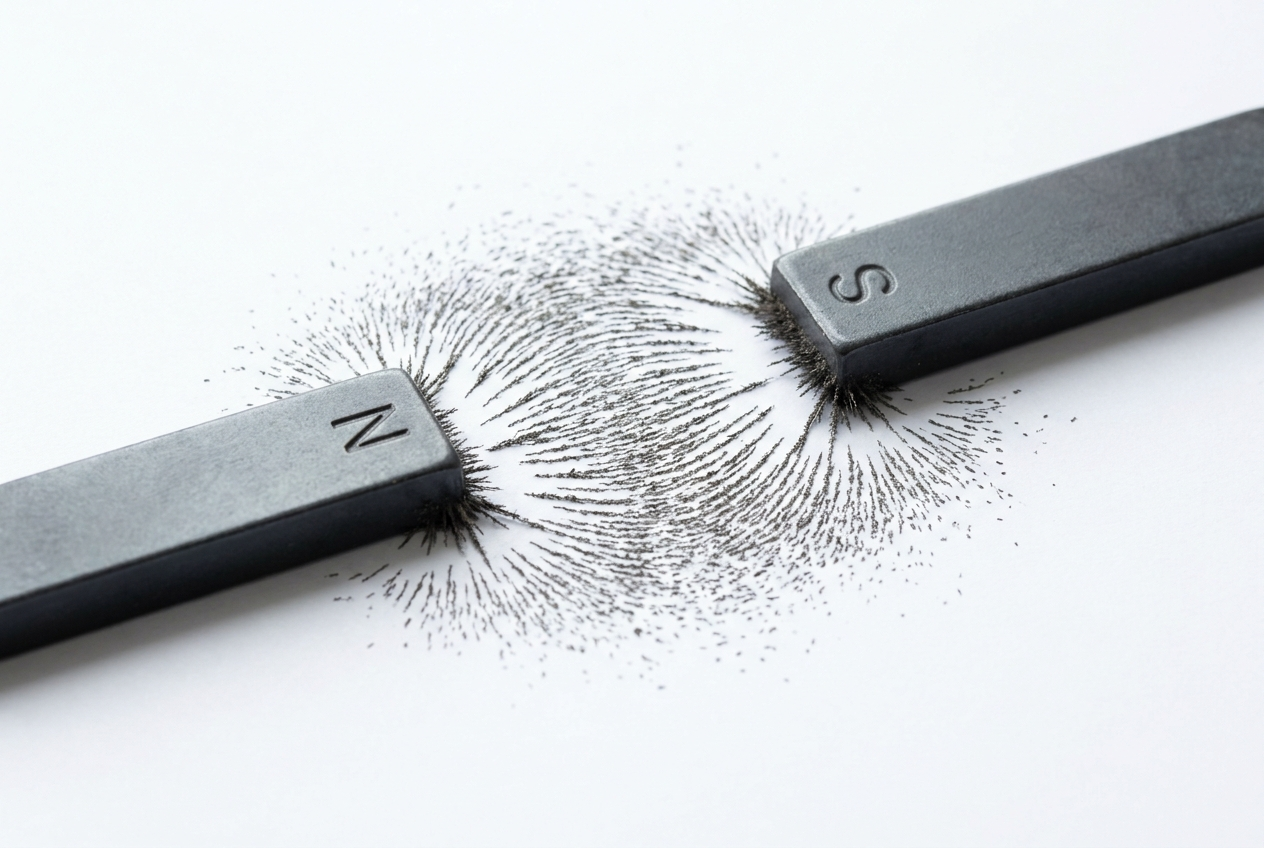
Everything about an electric motor comes down to one fundamental physical principle: electric currents generate magnetic fields, and magnetic fields exert forces on each other.
You may remember from school that magnets have a north pole and a south pole, opposite poles attract each other, like poles repel. An electric motor uses this principle by creating a magnetic field with electricity (an electromagnet) and positioning it so that it interacts with another magnet, creating a force. When that force is applied in a circular arrangement, you get rotation, and rotation drives the wheels.
The genius of an electric motor is that by carefully controlling the timing and direction of the electrical current through the electromagnets, you can create a continuously rotating force. The motor doesn't have discrete power strokes like a petrol engine, it produces torque smoothly and continuously throughout its rotation.
The two main parts: stator and rotor
Every electric motor, regardless of its specific design, consists of two fundamental parts:
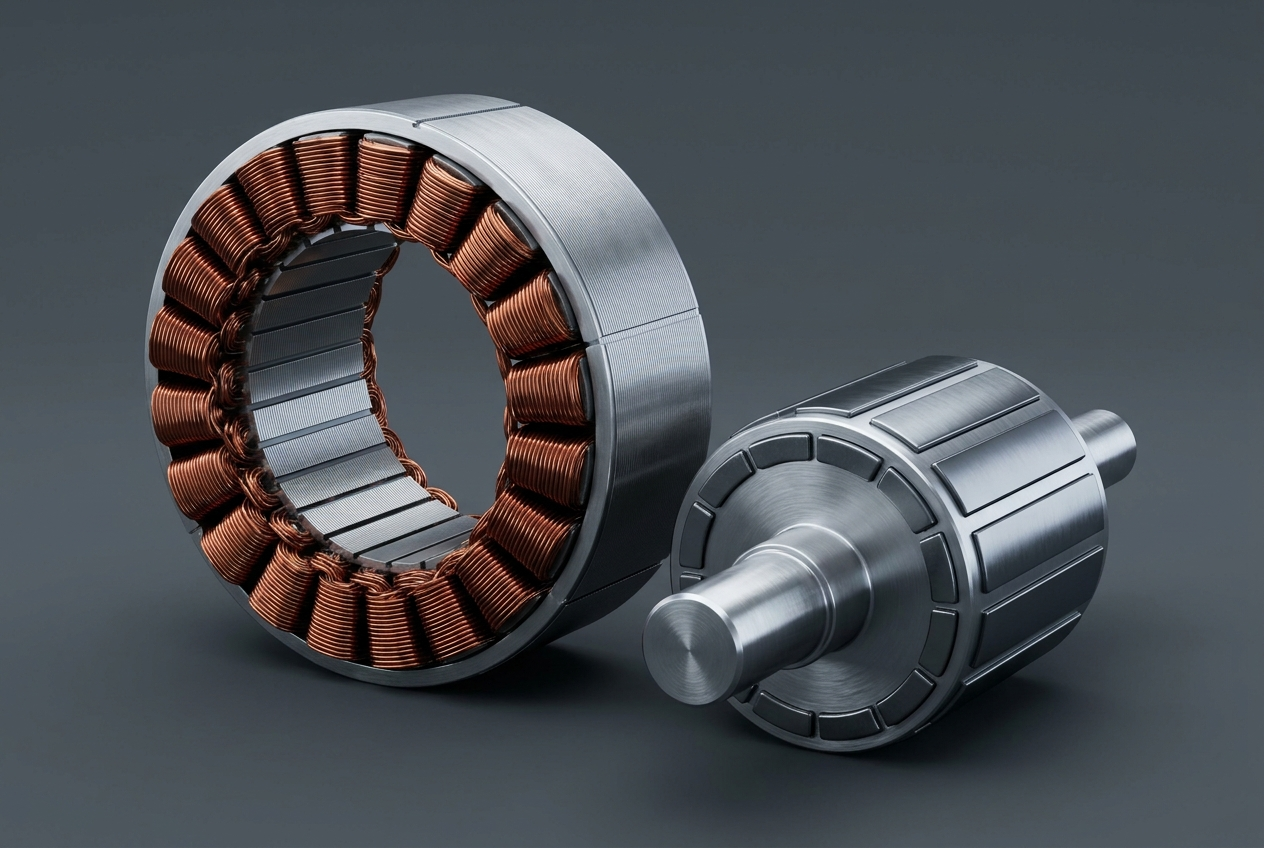
The stator is the stationary outer part. It contains coils of wire (windings) wound around an iron core. When electric current flows through these coils, they generate a magnetic field.
The rotor is the inner rotating part. It's connected to the output shaft, which ultimately drives the wheels. The rotor is designed to interact with the magnetic field produced by the stator, and that interaction is what creates rotational force (torque).
How the rotor responds to the stator's magnetic field depends on which type of motor design is used, and this is where the two main EV motor types diverge.
Type 1: Permanent magnet motors (most common in modern EVs)
In a permanent magnet motor, the rotor is embedded with strong permanent magnets, typically made from rare-earth materials like neodymium. These magnets create a constant, stable magnetic field.
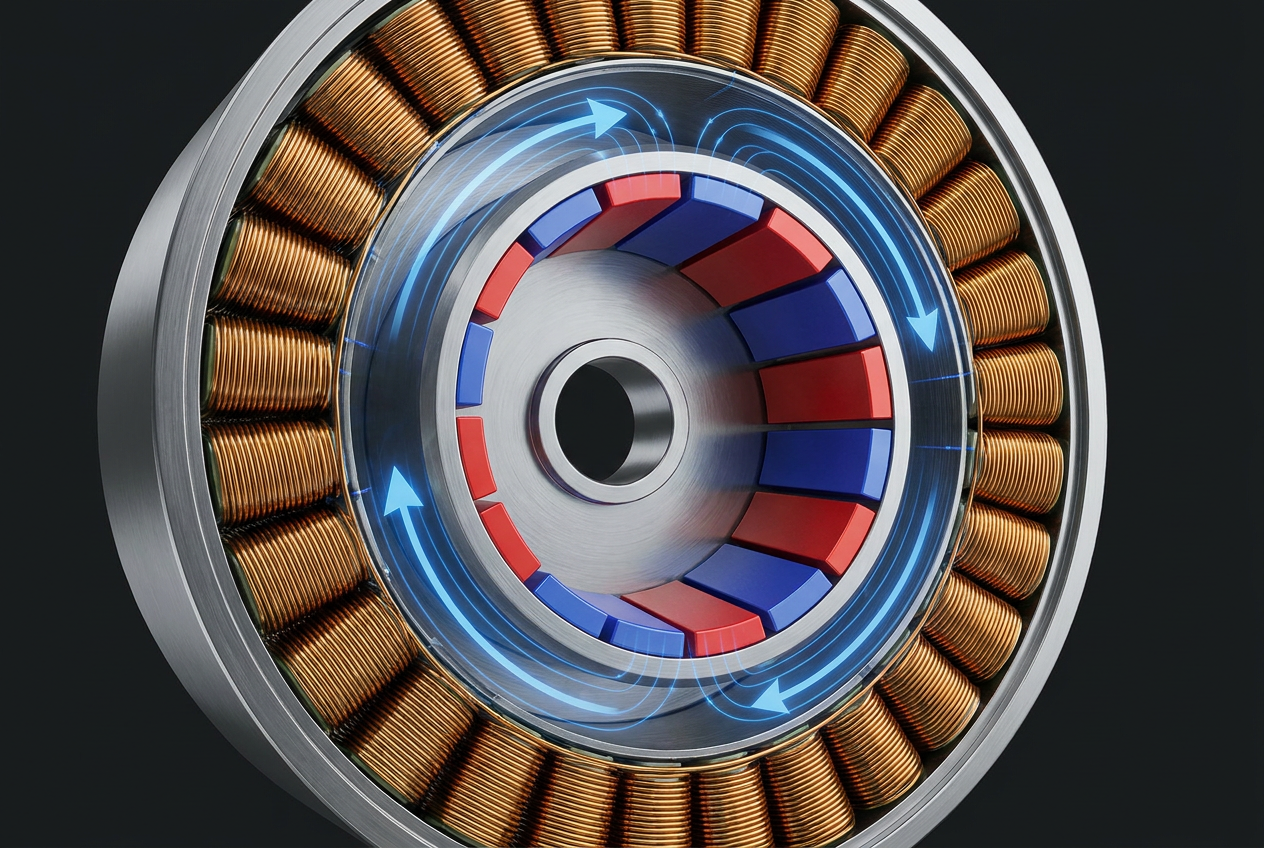
The stator generates a rotating magnetic field by feeding alternating current through its windings in a carefully timed sequence. Because opposite magnetic poles attract, the permanent magnets in the rotor are pulled around to follow this rotating field, like a compass needle constantly chasing a moving magnetic north.
The motor rotates synchronously with the rotating magnetic field, the rotor keeps up with the stator's field precisely, which is why these are called synchronous motors.
Why permanent magnet motors are excellent:
- Very high efficiency — up to 97.5% in the best designs, compared to around 20–40% for a typical petrol engine
- Excellent torque at low speeds — permanent magnets create a strong, stable field without requiring additional power input
- Compact and light for their power output — a 50kW permanent magnet motor typically weighs under 15kg
- Good at partial loads, which is where most everyday driving happens
Tradeoff: Permanent magnets require rare-earth materials, which add cost and supply chain complexity. At very high speeds, the permanent magnets can also generate resistance (back-EMF) that the system needs to manage.
Used by: Most Hyundai, Kia, BYD, MG, Tesla (rear motor on dual-motor models), Nissan Leaf, and the vast majority of modern EVs.
Type 2: Induction motors (AC induction)
In an induction motor, the rotor contains no permanent magnets. Instead, the rotor is made of conductive bars (typically aluminium or copper) arranged in a cage-like structure, sometimes called a "squirrel cage" motor.
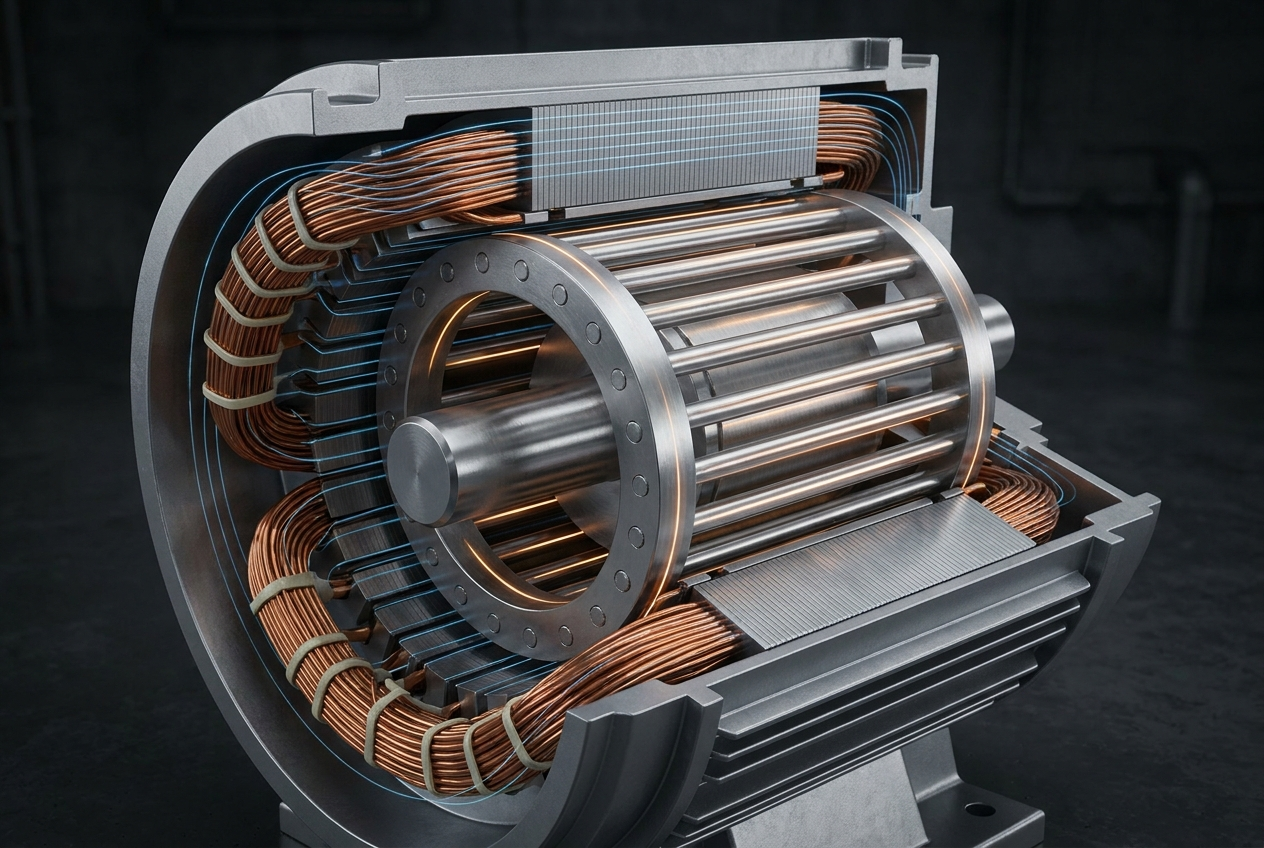
When the stator's rotating magnetic field passes over the conductive rotor bars, it induces an electrical current in them (hence "induction"), by the same principle of electromagnetic induction that makes a generator work. That induced current creates its own magnetic field in the rotor, which then interacts with the stator's field to produce rotation.
The rotor always spins slightly slower than the stator's rotating field, this "slip" is what sustains the induction effect. Without slip, no current would be induced, and the motor would produce no torque.
Why induction motors are useful:
- No rare-earth materials required — cheaper and simpler to manufacture
- Extremely robust and durable — the rotor has no magnets to demagnetise or complex windings to fail
- Low spin loss when powered off — when the motor isn't being driven, it offers minimal resistance to rotation, which is helpful for coasting
- Proven, well-understood technology — AC induction motors have been used industrially for well over a century
Tradeoffs: Slightly lower efficiency than permanent magnet motors at partial loads. The slip effect reduces precision compared to synchronous designs. Require more sophisticated electronic control to achieve fine torque management.
Used by: Tesla (front motor on dual-motor models), some older EVs.
Why many modern EVs use both
Several dual-motor EVs, most notably certain Tesla models, use an induction motor on one axle and a permanent magnet motor on the other. This is a deliberate engineering choice that exploits the strengths of each type:
- At low speeds and high torque (stop-and-go traffic, hill climbing, acceleration from standstill): the permanent magnet motor excels, it delivers strong, efficient torque precisely where it's most needed.
- At highway speeds with light loads (cruising): the induction motor on the other axle can be switched off entirely, since it has low spin loss when unpowered. The permanent magnet motor handles the light cruising load efficiently on its own.
- Under maximum acceleration: both motors are combined for peak output.
The vehicle's control system makes these decisions dozens of times per second, invisibly and continuously optimising which motor (or combination) is doing what.
The inverter: the component that makes it all work
The battery stores electricity as DC. But both permanent magnet and induction motors require AC to create the rotating magnetic field in the stator. Between the battery and the motor sits the inverter, a critical component that converts DC from the battery into precisely controlled AC for the motor.
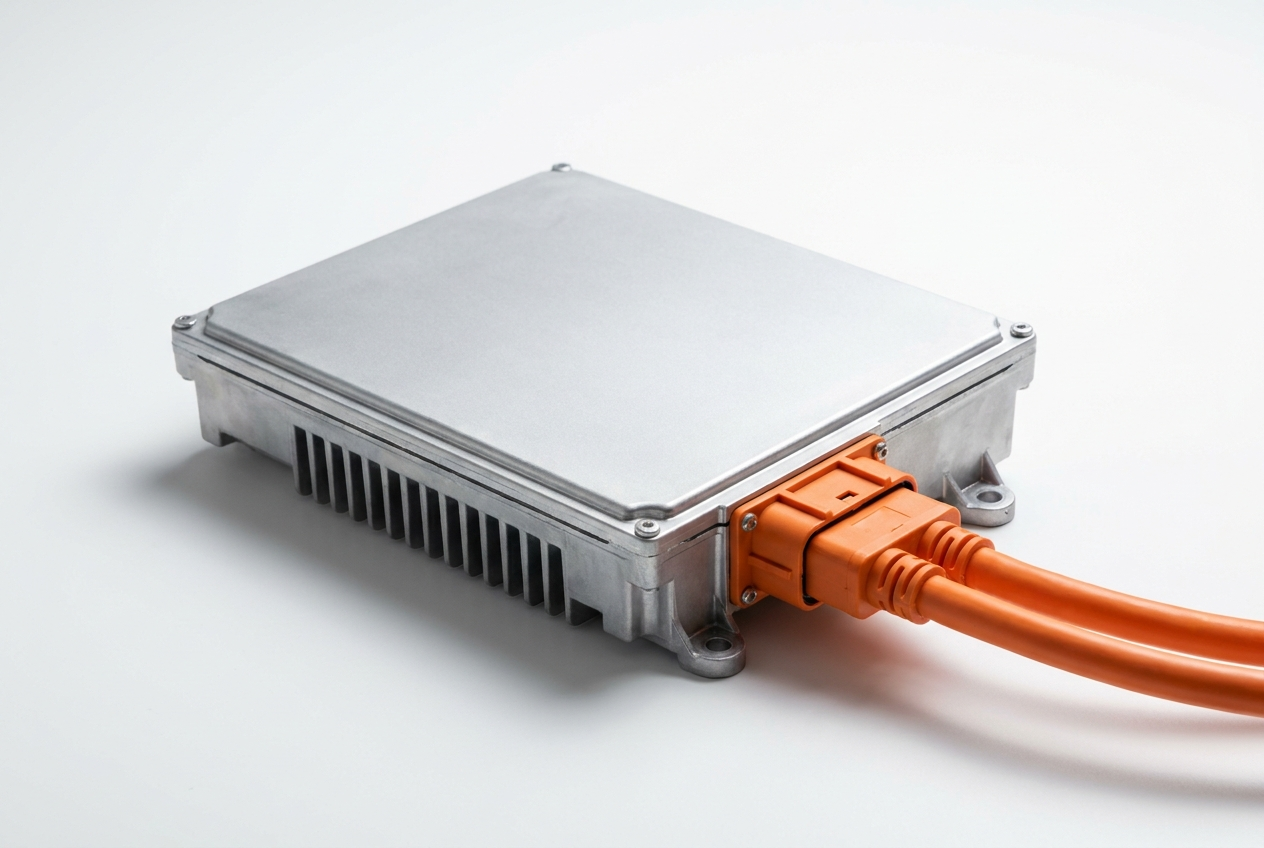
The inverter doesn't just convert the current, it controls the frequency of the AC it produces, which directly controls the motor's speed. Increase the frequency of the AC, and the rotating magnetic field spins faster, so the motor spins faster. The inverter is what allows the motor controller to respond to the accelerator pedal in real time, delivering exactly the torque the driver is requesting.
In regenerative braking, this entire process runs in reverse: the motor acts as a generator, the inverter converts the generated AC back into DC, and that DC flows back into the battery.
Why electric motors are so much better than petrol engines for vehicles
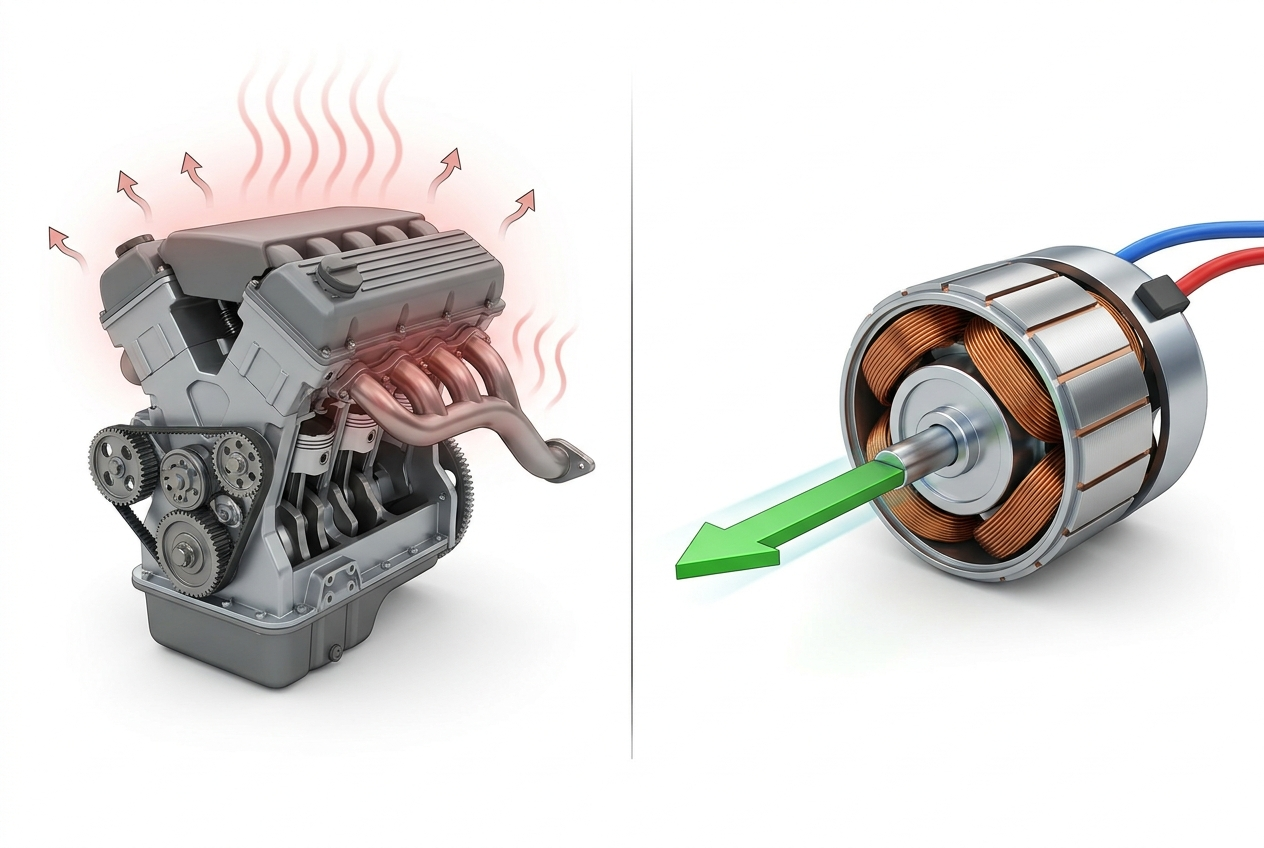
Instant torque: A petrol engine produces maximum torque at a specific RPM, the engine needs to be revved up to deliver its best. An electric motor produces its maximum torque from zero RPM. The moment current flows, full torque is available, which is why EVs feel so immediate and responsive from a standing start.
Linear power delivery: Because there are no discrete gear shifts (or on vehicles with a single fixed-ratio drive, no gears at all), power delivery is perfectly smooth and continuous.
Extraordinary efficiency: The best petrol engines convert around 35–40% of fuel energy into motion; the rest is lost as heat. A good permanent magnet motor is 90–97% efficient, the vast majority of the electrical energy drawn from the battery actually reaches the wheels.
Simplicity: A typical EV motor has around three moving parts. A petrol engine has hundreds. Fewer parts means less to wear, less to maintain, and greater reliability over time.
Silence: Electric motors are extraordinarily quiet. The humming or whirring you sometimes hear from an EV at low speed comes primarily from tyre and wind noise, or from gear reduction units, the motor itself produces almost no audible sound.
The gearbox (or lack of one)
Most EVs use a single fixed-ratio reduction gear between the motor and the wheels, not a multi-speed gearbox. This is possible because an electric motor produces usable torque across an extremely wide speed range, unlike a petrol engine which needs a multi-ratio gearbox to keep it in its efficient operating band. The reduction gear simply converts the motor's high-speed rotation into lower-speed, higher-torque output for the driven wheels.
Some high-performance EVs (such as the Porsche Taycan) use a two-speed transmission to optimise both low-speed torque and high-speed efficiency, but this is the exception. For the overwhelming majority of EVs, the elegant simplicity of a single reduction ratio is sufficient.
Disclaimer
The content in this post is based on our own research, experience, and opinion and is intended for general informational purposes only. It does not constitute professional technical advice. While we strive for accuracy, specific motor types, architectures, and performance characteristics vary between vehicle makes, models, and years. We encourage readers to consult manufacturer documentation for model-specific technical details.
Target keywords: how does EV motor work, electric motor explained, permanent magnet vs induction motor EV, how does electric car motor work
Last updated: June 2026